Last updated November 15, 2026 · By Creative Row editorial team
At a glance
- Give every supplier the same product, message and version list.
- Compare the known total plus exclusions; unknown costs stay unknown.
- Check accepted work, rights and internal review time alongside price.
A useful promo-video price starts with a defined job: what needs to be filmed or assembled, which message the video carries, and which finished versions you will receive. Compare suppliers against that same brief. A lower headline quote can become the more expensive option when filming, captions, additional exports or usage costs sit outside it.
For an ecommerce buyer, the first question is usually practical: do we need someone to edit footage we already have, create a new product demonstration, or handle the brief and production together? Those are different purchases. Putting them into one average price hides the decision you need to make.
Why a single price range is a poor starting point
A 15-second edit from approved footage is a different job from a 15-second scene that needs a location, crew, product samples and talent. Runtime describes the output. It does not describe all the work required to make it.
Public supplier pages show why scope matters. Venture Videos' promotional-production page describes production planning, scripting and review alongside a stated starting investment. Its positioning and project scope are not an ecommerce market average or a Creative Row quote. Read the supplier's own explanation.
Use published prices to understand the buying model, then ask for a matched scope. Do not divide a brand-film starting price by its runtime to estimate the cost of a product cutdown.
Decide which production job you are buying
If the footage is usable and the message is settled, ask for editing: sequencing, sound, graphics, captions and agreed exports. Include a sample of the actual footage in the request. An editor cannot price around missing coverage they have not seen.
If the product needs to be demonstrated, ask what filming includes. Who supplies the product? Does the demonstration require a particular location, setup or person? Who verifies that the product shown is the correct variant? A shot list helps turn “film the product” into an estimable task.
If the team has an objective but no clear message, include creative development. Ask whether audience research, concepts, scripting and storyboards belong in the quote. A price for execution alone does not solve an unresolved brief.
Animation and generated imagery need their own scope too. Ask what reference assets, product checks, specialist work and revision stages are included. A different production method does not remove the need to represent the product accurately.
Send every supplier the same short request
Start with one SKU, one buyer doubt and one intended action. Attach the approved product facts, available footage, brand assets and a reference that explains the treatment you want. State what you like about the reference; a link alone leaves too much room for interpretation.
Then define the deliverables. For example, one concept with two different openings produces two planned edits. Export each in two agreed formats and the handover contains four files. That is four files, not four different creative ideas.
Specify the runtime, placement, language and caption treatment for each version. Ask suppliers to mark every item included, excluded or awaiting input. Fluence's service page lists briefing, scripting, footage production, cutdowns and exports as possible components of an engagement; it is a useful reminder that “a video” can describe a much larger bundle. See its stated deliverables.
“How many promos can you film in a day?”
That question appeared in a public r/videography discussion about a clinic-video quote. The creator described a client questioning the price while treating the job as time with a camera. It is one provider-side account from a different category, not a price benchmark.
The useful response is to define what a filming day produces and what happens around it: preparation, approved setups, editing, review and the final version list. Ask how the supplier handles a missing shot discovered in review. A day rate without those boundaries leaves the buyer’s actual question unanswered.
Read the quote in six parts
First, check creative development. Is the supplier executing your approved script, developing the message, or doing both? Record who approves the script before production begins.
Second, check production inputs. Filming, samples, shipping, talent, locations, music and specialist assets should have an owner. An excluded cost is manageable when it is explicit. An unknown cost should remain unknown until someone confirms it.
Third, check the version list. “Social cutdowns” needs a count and specification. So does “captions included”: identify language, whether text is embedded or supplied separately, and who checks it against the final edit.
Fourth, check revisions. Correcting a misread product label and requesting a new demonstration scene are different changes. Agree on review rounds, who consolidates feedback, and what happens when the approved brief changes. Do not assume every new request belongs in an included round.
Fifth, check usage and handover. List intended channels, duration, territory and reuse needs, then ask the supplier to confirm the relevant permissions and exclusions. Ask separately about editable project files and source footage. Receiving a final export does not answer those handover questions.
Sixth, check delivery. Does the date mean first edit, revised version or final files? Which inputs and approvals start or pause the clock? A calendar promise without those conditions is difficult to compare.
A worked quote comparison
The following numbers are invented to demonstrate the method. They are not market rates, supplier offers or Creative Row prices. Assume the same brief requires four final files, a small product shoot and agreed paid-use permissions.
Illustrative USD amounts only; same four-file requirement
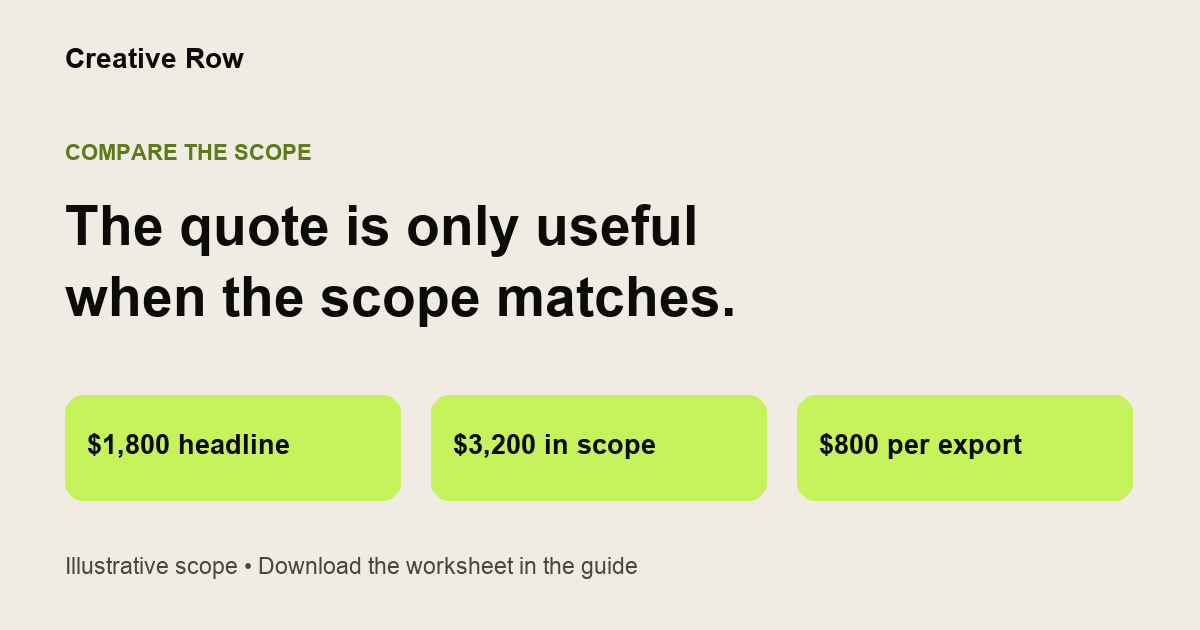
- Headline quote: Supplier A: $1,800; Supplier B: $2,800.
- Required shoot outside headline: Supplier A: $800; Supplier B: $0 — included in this illustration.
- Required captions/exports outside headline: Supplier A: $200; Supplier B: $0 — included in this illustration.
- Agreed usage allowance outside headline: Supplier A: $400; Supplier B: $200.
- Comparable total: Supplier A: $3,200; Supplier B: $3,000.
- Required final exports: Supplier A: 4; Supplier B: 4.
- Cash cost per required export: Supplier A: $800; Supplier B: $750.
Supplier A starts at $1,800. After the example's excluded shoot, caption/export work and usage allowance, the comparable cash scope is $3,200. Supplier B starts at $2,800 and reaches $3,000 after its stated usage allowance. For four files, those totals are $800 and $750 per required export.
That calculation does not make B better. Check work quality, product accuracy, responsibilities and delivery risk. It also does not turn four exports into four concepts. The comparison only makes the assumed cash scope visible.
If a supplier cannot confirm a rights or production cost, show the known subtotal plus that unresolved item. Do not enter zero to make the spreadsheet balance. If the proposed outputs differ, normalize the scope first rather than divide unequal packages by their file counts.
Generated clips still need a finished-work scope
Yesilcam Studios’ promotional-video pricing guide separates production approaches and generation costs. Its vendor-authored Turkish-market examples are useful context, not transferable market rates. When comparing generated and filmed work, price the approved result: product checks, continuity fixes, sound, captions, review and permitted use. A generation credit does not describe the whole handoff.
Include the time your own team will spend
A supplier quote is only one part of the buying decision. Someone must prepare product facts, find usable footage, give feedback and approve the outputs. An editing-only offer can be a good fit when your team can do that work. It can be a poor fit when those responsibilities are the bottleneck.
Track internal hours separately from supplier fees. If you have an approved internal cost rate, you can model that time; otherwise leave the monetary value unknown. Do not present an invented labor rate as a measured saving.
For recurring production, compare the workload you can actually brief and approve each month. A subscription with idle capacity can cost more per accepted output even when the advertised unit economics look attractive. Conversely, a consistent workload may justify a recurring arrangement that reduces repeated procurement.
Questions worth resolving before signing off
What exactly will arrive? Which missing inputs can change the quote? Who approves the product facts and final versions? Which costs are fixed, optional or still unknown? What counts as a scope change? What usage and handover terms have been agreed?
Put the answers beside the quote. A cheaper number is useful only when you know which work it buys.
Common questions
How much should a short promotional video cost?
There is no defensible universal amount based on duration alone. Start with the production method, available inputs and final version list. Request comparable quotes and normalize exclusions before deciding what is affordable.
Is a monthly creative service cheaper than a project?
It depends on the work you use, the capacity reserved and the service boundaries. A recurring package suits an ongoing queue better than an isolated job. Compare the same expected workload, commitment and approval capacity; neither billing model is automatically cheaper.
Does the cheapest cost per file win?
No. Per-file cost is a scope check, not a quality or business-outcome measure. A file that misrepresents the product or cannot be used in its intended placement is not a successful handover.
Use the quote worksheet
Download the blank comparison sheet and send the same brief to each supplier. Keep confirmed costs, exclusions and unresolved items separate. Use the filled example to understand the arithmetic, then replace every invented amount with a real quote.
Download the blank quote worksheet · Download the illustrative comparison
Sources and editorial scope
Public supplier descriptions and linked discussions checked November 15, 2026. Supplier statements are attributed to their own pages. Community accounts illustrate questions; they are not representative research. The worksheets, selection framework and fictional examples are Creative Row editorial guidance. No supplier quote, client result or measured performance test is implied.